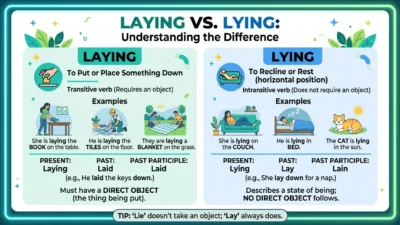

Many people feel confused about “lay” and “lie.” Even native speakers mix them up. The reason is simple: both words are about putting something down or resting, and their forms change in tricky ways.
But don’t worry. In this guide, you will learn the difference in very simple English. By the end, you will understand clearly and use them correctly in daily life.
Quick Answer
Here is the easiest way to remember:
- Lay = put something down (needs an object)
- Example: I lay the book on the table.
- Lie = rest or recline (no object needed)
- Example: I lie on the bed.
Key idea:
- Lay → you do something to something
- Lie → you do it yourself
Simple Background
The confusion comes from old English forms. Over time, the verbs changed, but their past forms became very similar.
Here’s what makes it tricky:
- The past tense of “lie” is “lay”
- The past tense of “lay” is “laid”
Yes, this is why people get confused!
Clear Explanation of the Difference
Let’s break it down step by step.
1. “Lay” (needs an object)
“Lay” means to put something somewhere.
You must have an object (a thing).
Structure:
- Subject + lay + object
Examples:
- I lay the keys on the table.
- She lays the baby in the crib.
- They are laying the carpet.
👉 Ask yourself: What are you putting down?
If you can answer, use lay.
2. “Lie” (no object)
“Lie” means to rest or be in a flat position.
No object is needed.
Structure:
- Subject + lie
Examples:
- I lie on the sofa.
- He lies on the grass.
- They are lying on the floor.
👉 Ask yourself: Are you just resting?
If yes, use lie.
3. Important Verb Forms
This is where many learners struggle.
“Lay” forms:
- Present: lay / lays
- Past: laid
- Past participle: laid
- -ing: laying
Example:
- Today: I lay the book down.
- Yesterday: I laid the book down.
“Lie” forms:
- Present: lie / lies
- Past: lay
- Past participle: lain
- -ing: lying
Example:
- Today: I lie down.
- Yesterday: I lay down.
- Before: I have lain down.
Comparison Table
| Feature | Lay | Lie |
| Meaning | Put something down | Rest or recline |
| Object needed? | Yes | No |
| Example | Lay the bag here | Lie on the bed |
| Past tense | Laid | Lay |
| Past participle | Laid | Lain |
| -ing form | Laying | Lying |
Which One to Use and When
Here is a simple way to choose:
Use “lay” when:
- You move or place something
- There is an object
Examples:
- Lay the phone on the desk.
- She lays the clothes on the chair.
- He laid the tools outside.
Use “lie” when:
- You are resting
- No object is involved
Examples:
- I lie down after work.
- The dog lies on the floor.
- She lay on the bed yesterday.
Quick Trick
Use this question:
👉 “Am I putting something somewhere?”
- Yes → Lay
- No → Lie
Common Mistakes People Make
Let’s look at mistakes and fix them.
Mistake 1:
❌ I am laying on the bed.
✅ I am lying on the bed.
(You are resting, not placing something.)
Mistake 2:
❌ Please lie the book here.
✅ Please lay the book here.
(You are placing the book.)
Mistake 3:
❌ Yesterday, I laid on the sofa.
✅ Yesterday, I lay on the sofa.
(Past of “lie” is “lay”.)
Mistake 4:
❌ He has laid there all day.
✅ He has lain there all day.
(Correct past participle of “lie” is “lain”.)
Everyday Real-Life Examples
Here are examples from daily life so you can see how people use these words.
1. At Home
- Lay your clothes on the bed.
- I lie down when I feel tired.
- She laid the plates on the table.
2. In Emails
- Please lay the documents on my desk.
- I will lie down for a short break.
3. In News or Reports
- The workers laid new pipes in the city.
- The patient lay in the hospital for two days.
4. On Social Media
- Just lying on the couch watching TV.
- I laid everything out before packing.
5. In Daily Conversation
- Lay the keys here.
- Let me lie down for a minute.
- He laid his phone next to him.
Short Learning Section (For Students and Beginners)
Here is a simple way to practice:
Step 1: Remember the meaning
- Lay = put something
- Lie = rest
Step 2: Practice with questions
Ask yourself:
- “Is there an object?”
- “Am I placing something?”
Step 3: Try simple sentences
Fill in the blanks:
- Please ___ the book here.
- I want to ___ down.
- Yesterday, I ___ on the sofa.
- She ___ the bag on the chair.
Answers:
- lay
- lie
- lay
- laid
Step 4: Repeat daily
Use these words in small sentences every day. Practice makes it easy.
FAQ Section
1. What is the main difference between lay and lie?
“Lay” means to put something down. “Lie” means to rest.
2. Does “lay” always need an object?
Yes. You must place something.
3. Does “lie” need an object?
No. It is about your own position.
4. Why is the past tense confusing?
Because the past of “lie” is “lay,” which looks like the present of “lay.”
5. Is “lying” correct for resting?
Yes. “I am lying on the bed” is correct.
6. What is the past of “lay”?
The past of “lay” is “laid.”
7. What is the past participle of “lie”?
It is “lain.”
8. How can I remember easily?
Think:
- Lay → place something
- Lie → rest yourself
Conclusion
“Lay” and “lie” can seem confusing at first, but the difference is actually simple.
- Lay = put something down (needs an object)
- Lie = rest or recline (no object)
The biggest problem comes from their past forms, but with practice, you will get used to them.
Keep using the simple trick:
👉 Am I placing something, or just resting?
With regular practice, you will use “lay” and “lie” correctly without thinking twice.

Justin Larry is a talented language writer and content creator at WordHuts.com. She specializes in explaining word differences, grammar tips, and common English mistakes in a clear, practical style. Her engaging content helps readers improve vocabulary, writing skills, and everyday communication, making language learning simple and effective.