Many English learners get confused by peoples and peoples’. They look almost the same, but they are used in different ways. One is a plural noun, and the other is a possessive form.
A tiny apostrophe can change the meaning of a word. That is why this pair can be tricky. The good news is that once you understand the basic rule, it becomes very easy.
This guide will explain everything in simple English. By the end, you will know exactly when to use peoples and when to use peoples’.
Quick Answer
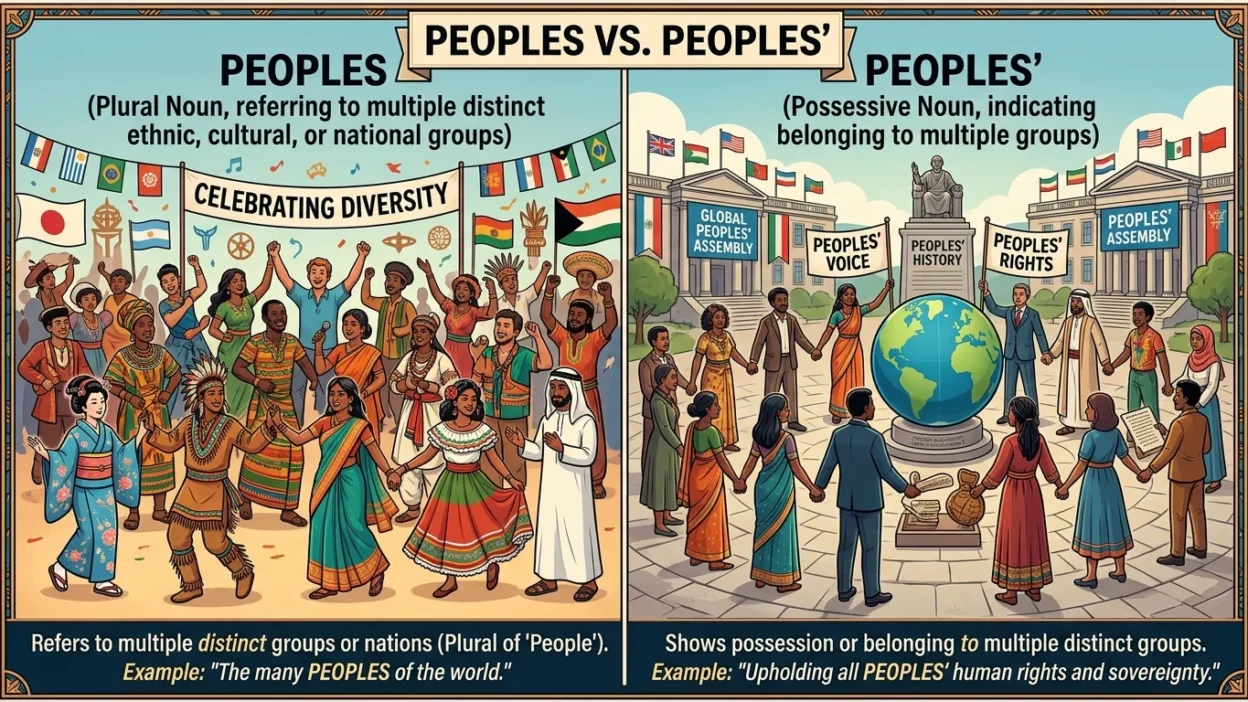
- Peoples is the plural form of people.
- It means different groups of people, often from different nations, cultures, or communities.
- Peoples’ is the possessive form of peoples.
- It means something belongs to or is connected with many groups of people.
Simple examples
- The world is home to many peoples.
- We must respect all peoples’ traditions.
Where These Words Come From
The word people usually means a group of persons.
- One person → person
- More than one person → people
But English has an extra form: peoples.
This word is used when talking about more than one distinct group of people. For example, different ethnic groups, nations, or cultures.
So:
- people = humans in general, or one group
- peoples = many separate groups of people
Then we add an apostrophe after peoples to show possession:
- peoples’ = belonging to many groups of people
The Main Difference
Peoples
Peoples is a plural noun.
It refers to multiple groups, communities, or nations.
Example:
- The museum celebrates the history of Indigenous peoples.
This means many different Indigenous groups.
Peoples’
Peoples’ is a possessive plural noun.
It shows that something belongs to those groups.
Example:
- The law protects Indigenous peoples’ rights.
The rights belong to those peoples.
Comparison Table
| Word | Part of Speech | Meaning | Example |
| peoples | Plural noun | many separate groups of people | Many peoples live in this region. |
| peoples’ | Possessive plural noun | belonging to many groups of people | We honor these peoples’ customs. |
When to Use Each One
Use peoples when:
- You are talking about several groups or nations.
- You mean different cultures or communities.
- Nothing is being owned.
Examples:
- The island was once home to several peoples.
- Different peoples have different traditions.
- The conference brought together native peoples from around the world.
Use peoples’ when:
- Something belongs to those groups.
- You want to show ownership, connection, or association.
Examples:
- We must protect all peoples’ languages.
- The book explores many peoples’ histories.
- Their art reflects the peoples’ shared values.
A Simple Trick to Remember
Ask yourself this question:
Is something being owned or connected?
- If no, use peoples.
- If yes, use peoples’.
For example:
- Many peoples live here. (Just groups)
- Many peoples’ stories are told here. (The stories belong to them)
Common Mistakes
Mistake 1: Using peoples when possession is needed
❌ We respect all peoples culture.
✅ We respect all peoples’ culture.
Mistake 2: Adding an apostrophe when it is not needed
❌ Many peoples’ live in the area.
✅ Many peoples live in the area.
Mistake 3: Confusing people and peoples
❌ The world has many people with unique traditions. (Grammatically correct, but not the best choice if you mean distinct cultural groups.)
✅ The world has many peoples with unique traditions.
Everyday Examples
In Emails
- We value the voices of all peoples.
- Our program supports Indigenous peoples’ education.
In News Writing
- The festival celebrated the art of many peoples.
- Leaders discussed peoples’ rights and freedoms.
On Social Media
- Learning about different peoples is exciting.
- We should honor all peoples’ traditions.
In Daily Conversation
- Many peoples have lived on this land.
- These songs tell the peoples’ stories.
Learning Tips for Students and Beginners
Here is an easy way to remember:
- Peoples = groups
- Peoples’ = groups + ownership
Think of the apostrophe as a small sign that says:
“This belongs to someone.”
Practice with these simple sentences:
- Many ______ live in the mountains.
- We respect these ______ beliefs.
Answers:
- peoples
- peoples’
FAQ
1. Is peoples a real word?
Yes, it is. It is the plural form used for different groups, nations, or cultures.
2. What does peoples’ mean?
It means something belongs to multiple groups of people.
3. Can I use people instead of peoples?
Sometimes, yes. But peoples is better when you mean separate cultural or national groups.
4. Why is the apostrophe after the s?
Because peoples is already plural. The apostrophe after the s shows plural possession.
5. Is peoples’ common in everyday writing?
It is less common than people, but it is often used in history, culture, law, and human rights writing.
6. Which is more common: people or peoples?
People is much more common in everyday English.
7. Can peoples refer to countries?
Yes. It can refer to the people of different nations or ethnic groups.
8. How can I check which one to use?
Ask: Does something belong to these groups? If yes, use peoples’.
Final Thoughts
The difference between peoples and peoples’ is simple once you know the rule.
- Peoples means many separate groups of people.
- Peoples’ means something belongs to those groups.
Remember:
- No ownership? Use peoples.
- Ownership or connection? Use peoples’.
A single apostrophe makes all the difference. With a little practice, you will use both forms correctly and confidently.

Brandon Samuel is a dedicated writer and language enthusiast, serving as the lead author at WordHuts.com. He specializes in explaining word differences, grammar rules, and common language mistakes in simple terms. Brandon’s clear, practical writing style helps readers improve vocabulary, writing confidence, and everyday communication skills.